
What is a heat interface unit?
A heat interface unit takes hot water from your building's plant room and uses it to run your radiators and taps.
A heat interface unit, or HIU, is the box in the cupboard in a flat on communal or district heating. It does not burn anything and it has no flue. Hot water is piped to it from a central plant room serving the whole building, and the unit uses that heat to run your radiators and to heat your tap water on demand. If you live in a newer flat and cannot find a boiler, this is why.
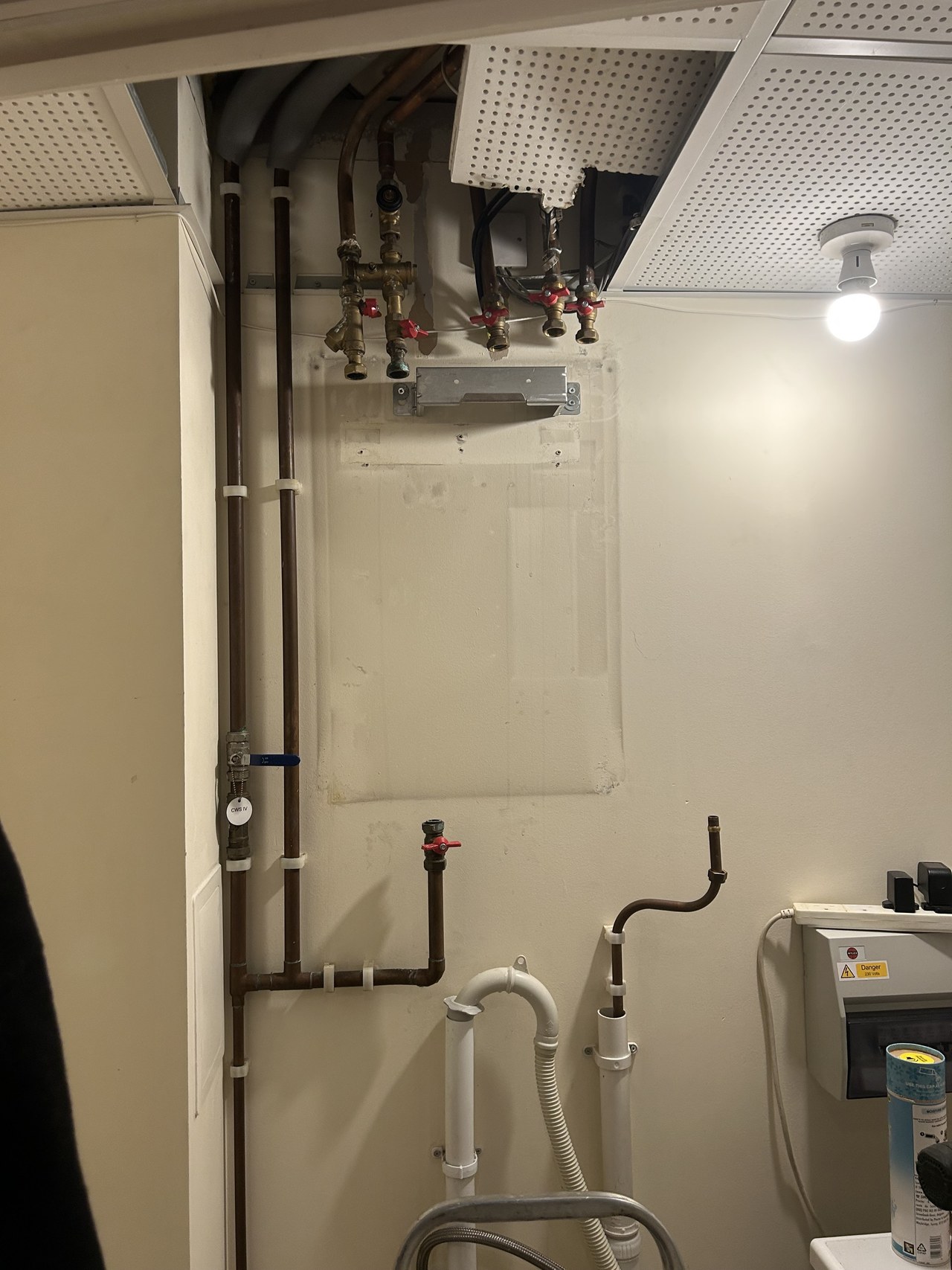
How a heat interface unit works
Think of it as a heat exchanger with controls on it rather than an appliance. Two pipes come into your flat from a riser, one flow and one return. The water in them is heated centrally, in a plant room that might be in the basement, on the roof, or in a separate energy centre serving several buildings.
Inside the unit, that hot water passes through one side of a plate heat exchanger. A plate heat exchanger is a stack of thin metal plates with alternating channels, so two separate circuits of water can run within millimetres of each other and transfer heat without ever mixing. Your tap water runs through the other side and comes out hot.
Most units have two of these. One does your hot water on demand, the moment you open a tap. The other feeds your heating circuit, so your radiators run on water that stays inside your flat. The building's water and your water never meet, which is the whole point of the design.
A motorised valve, usually called the actuator, decides how much of the building's hot water is let through, and when. The controls open it when you ask for hot water or when the thermostat asks for heat. That is essentially all a heat interface unit is: an exchanger, a valve, a couple of strainers and some controls.
Why your flat has one instead of a boiler
A block with one large, efficient, centrally maintained plant is generally cheaper to run and easier to regulate than a hundred individual appliances. It also means no gas supply into individual flats, no flues through the facade, and no individual appliance servicing obligation on each resident.
For a developer there is a planning advantage too: communal and district heating is favoured in many local plans, which is why almost every new block of any size built in London and the Thames corridor over the last decade has one.
The trade-off is that you are connected to a shared system. When the building's supply has a problem, so does your flat, and you cannot fix that yourself. When your unit has a problem, nobody else notices.
What goes wrong with them
Three things account for most of the calls we get, and they are worth knowing in order of how common they are.
First, strainers block. There are small mesh filters on the incoming pipework whose job is to catch debris circulating in the building's system. They do that job until they are full. Then the flow through the exchanger drops, the exchanger cannot transfer the heat it should, and the hot water goes gradually lukewarm. This happens so slowly that most people never notice a day it changed.
Second, the actuator or the controls stop working properly, which usually shows as one circuit working and the other not. Heating fine and no hot water, or hot water fine and no heating, both point here rather than at the building's supply, because the supply feeds both.
Third, things leak. The unit sits in a cupboard, often above the flat below, and a slow leak can do quiet damage before anyone sees a mark.
How do I know what I have?
Open the cupboard. If what you find is a flat panel with two or three pipes going into it and no flue, no gas pipe and no visible burner, it is a heat interface unit. There will be a name on the front: Danfoss, Ideal, Worcester, Caleffi, V-therm, Evinox and Inta are the ones we see most.
If instead there is a gas pipe going into it and a flue going out through the wall, it is a gas boiler, and you need a Gas Safe registered engineer rather than us.
Take a photograph of the front, including the badge and anything on the display. That one photograph answers most of what an engineer needs to know before coming out.
Why some flats get better hot water than others in the same block
This is the question we get asked in person more than any other, usually by somebody who has compared notes with a neighbour and discovered theirs is worse.
Three things explain almost all of it, and only one is about the unit itself.
The first is where the flat sits on the riser. A building's hot water is pumped up through a vertical pipe serving a column of flats, and there is a pressure and temperature gradient along it. A flat at the far end of a long horizontal run on the top floor is working with slightly less than one near the plant room. Good system design minimises that; not all designs are good.
The second is the state of your own strainers. Two identical flats, one serviced and one not, will give noticeably different hot water, and the unserviced one is the one whose owner assumes the building is at fault.
The third is what the building is currently sending. Flow temperatures get turned down, sometimes for good efficiency reasons and sometimes because something in the plant room is not working properly. When that happens every flat gets worse together, which is why asking a neighbour is genuinely diagnostic.
It is worth establishing which of the three you are dealing with before spending anything, because only one of them is fixed by work inside your flat.
On the facts in this guide. How a heat interface unit works is described here from the plate heat exchanger principle common to every make. Anything that would differ between manufacturers, including error codes, set pressures and service intervals, is deliberately not stated as a number: check your own unit's manual or ask whoever manages the building.
Questions people ask
Is a heat interface unit a boiler?
No. A boiler burns fuel to make heat. A heat interface unit burns nothing at all: it takes heat that has already been made somewhere else in the building and transfers it into your flat through a heat exchanger.
Does an HIU use gas?
Not in your flat. The building's plant room might, but there is no gas supply to the unit itself, no burner and no flue.
Who is responsible for mine?
It depends on your lease or tenancy, and it genuinely varies between buildings. In many developments the unit inside the flat is the leaseholder's and the system up to it is the building's. Ask your managing agent before assuming either way.
Can I turn it off?
There are usually isolation valves on the pipes either side of it, and closing those is the right thing to do if it is leaking. Everything beyond that is an engineer's job.
How long do they last?
That depends on the make, the water quality in the building and whether anyone has ever serviced it, so there is no honest single figure. A unit that has been serviced will last considerably longer than one that has not.
Call us for your instant no-obligation quote
Tell us what needs doing and we will tell you what it takes. No obligation, and nothing starts until you have agreed the price.
Get in touch
Tell us what is happening and where the property is. A photo of the unit, the fault code or the leak answers more than a paragraph does.
The plumber was really good. He fixed the HIU that was leaking. Now it doesn’t leak anymore, and everything works perfectly. He did a great job!
Good HIU service, knows his staff well and very quick and the gentleman even helped fixed error code on ambiente heating system, which was not part…