
HIU vs boiler: what is the difference?
A heat interface unit and a boiler look alike and work completely differently.
A boiler makes heat by burning fuel. A heat interface unit makes no heat at all: it takes hot water produced centrally for the whole building and transfers that heat into your flat through a plate heat exchanger. A boiler needs a gas supply, a flue and an annual safety check. An HIU needs none of those, which is why flats on communal heating have them.
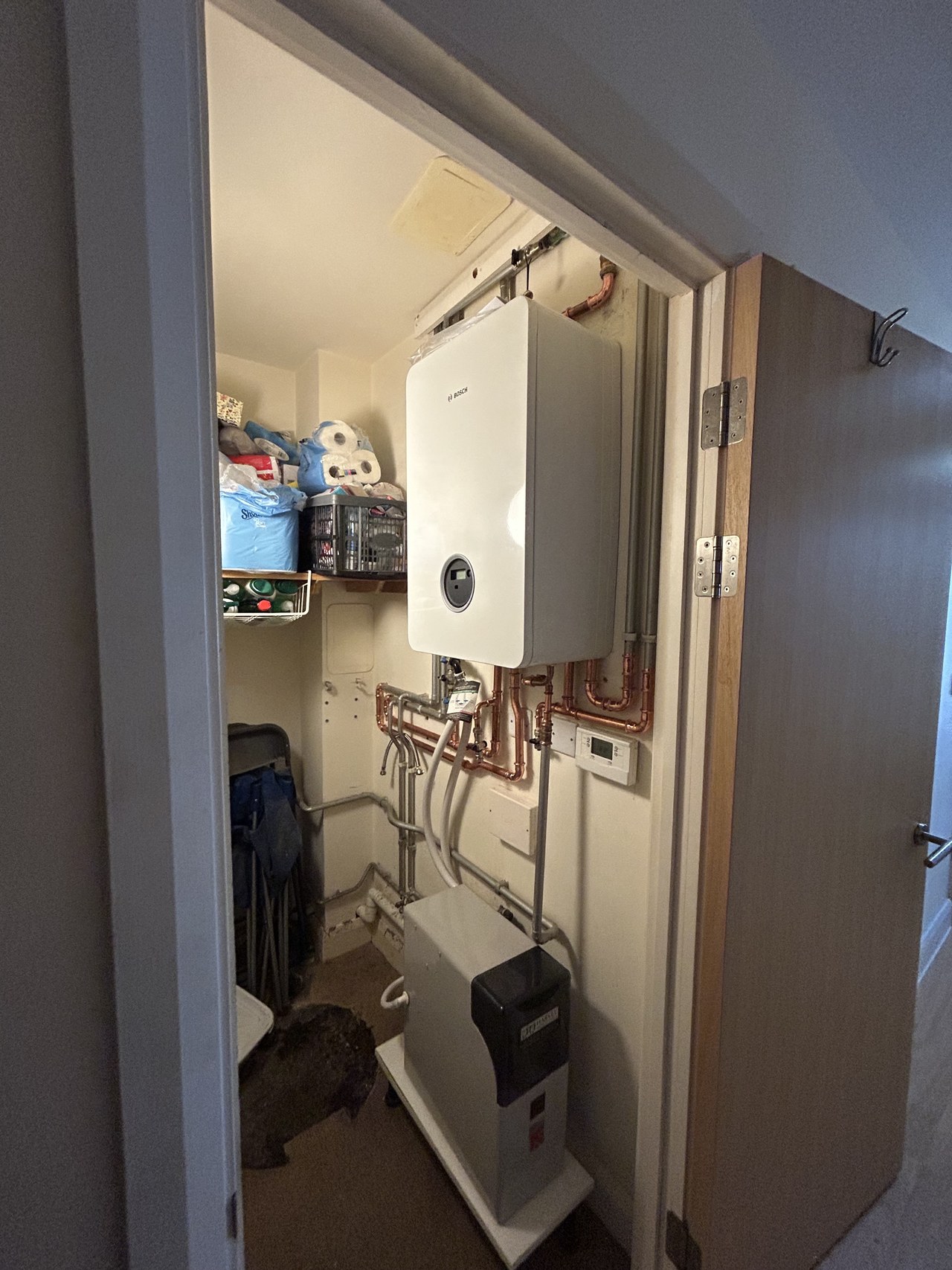
The fundamental difference
A boiler is a heat source. It burns gas or oil, and the products of that combustion have to leave the building through a flue. That is why a boiler has a gas pipe going in and a flue going out, and why working on one requires registration.
A heat interface unit is a heat exchanger. The heat has already been made, in a plant room that serves the whole building or sometimes several buildings. The unit's job is to take that heat out of the building's water and put it into yours, without the two ever mixing.
Everything else about the comparison follows from that single difference.
What it means day to day
There is no appliance servicing obligation on you in the gas sense, because there is no combustion. There is still a servicing need, but it is about flow and cleanliness rather than safety: strainers, exchangers and controls.
You do not control the temperature of the heat arriving. The building sets the flow temperature, and your unit works with what it is sent. If the building has turned its flow temperature down, your hot water will be affected and nothing inside your flat can compensate for it. That is a genuine difference in control that catches people out.
Your heating circuit is still yours. The radiators, the pipework and the pressure in them are inside your flat, which is why your unit has a pressure gauge reading your own system.
Billing works differently too
With a boiler you buy gas and you can change supplier. With communal heating you buy heat from the building's network, usually metered by a heat meter on the unit, at a rate set by the heat supply agreement, and you cannot shop around.
That is worth knowing because it changes who to talk to about a bill that looks wrong. An unexpectedly high heat bill is a conversation with the network operator or the managing agent, not an energy supplier, and occasionally it is a faulty heat meter rather than a tariff at all.
Which is better?
Neither, and it is not usually a choice you get to make. If you live in a flat on a heat network, you have a heat interface unit, and swapping it for an individual boiler would mean a gas supply and a flue that the building almost certainly will not permit.
What is fair to say is that a well-run heat network with a well-maintained unit is an efficient, quiet arrangement with no combustion in your home. A neglected unit on a badly-run network is a frustrating one, and most of the frustration people attribute to communal heating in general turns out, in a specific flat, to be a strainer nobody has cleaned.
The things people miss when they move into a flat with one
Most of our first conversations with a new resident cover the same handful of surprises, so they are worth listing.
There is no appliance to service in the gas sense, and no safety certificate to chase, but there is still a maintenance need. People who are used to an annual gas visit often assume no visit means nothing to do.
The hot water is instantaneous rather than stored, in most installations, so there is no cylinder to run out and no recovery time. But there is also nothing buffering a dip in the building's supply, which is why a problem in the plant room is felt immediately in the flat.
You cannot change supplier. The heat comes from the network at the rate in the heat supply agreement. People who move in and start shopping for a better tariff find there is nothing to shop for, and that is worth knowing before the first bill rather than after.
There is usually a heat meter, and it is the thing that decides your bill. If a bill looks wrong, the meter is as plausible a culprit as the tariff, and that is a conversation with the network operator.
And the unit is quiet. People sometimes report that theirs has stopped working when in fact it has simply never made a noise, because there is no burner firing and nothing to hear.
On the facts in this guide. How a heat interface unit works is described here from the plate heat exchanger principle common to every make. Anything that would differ between manufacturers, including error codes, set pressures and service intervals, is deliberately not stated as a number: check your own unit's manual or ask whoever manages the building.
Questions people ask
Can I replace my HIU with a combi boiler?
In practice almost never. It would need a gas supply into the flat and a flue through the building, and a block on a heat network will not normally permit either.
Is an HIU cheaper to run than a boiler?
It depends entirely on the heat network's tariff, which is set in the heat supply agreement rather than by you. The unit's efficiency matters far less to your bill than the network's price does.
Do I need an annual safety certificate?
Not in the gas sense, because nothing burns. Your building may still require annual servicing, which is a performance and maintenance matter rather than a safety certificate.
Why does my hot water depend on the building?
Because the heat is made centrally. Your unit transfers whatever the building sends it, so if the building's flow temperature drops, so does your hot water.
Do you work on both?
Only heat interface units. We are not Gas Safe registered and do not work on gas appliances of any kind.
Is a heat interface unit more reliable than a boiler?
It has far fewer parts and nothing that burns, so there is less to go wrong inside it. What it gains in simplicity it gives back in dependence: it relies on the building's system working properly, and you have no control over that.
Why is my flat warm when the heating is off?
Communal heating risers run through the building, and in some designs they give off enough heat to warm the flats around them. It is a known characteristic of heat networks rather than a fault with your unit.
Can I get a smart thermostat like a boiler has?
Generally yes, because the heating circuit is controlled much like any other. There is a separate guide on this site about what to check first.
Call us for your instant no-obligation quote
Tell us what needs doing and we will tell you what it takes. No obligation, and nothing starts until you have agreed the price.
Get in touch
Tell us what is happening and where the property is. A photo of the unit, the fault code or the leak answers more than a paragraph does.
The plumber was really good. He fixed the HIU that was leaking. Now it doesn’t leak anymore, and everything works perfectly. He did a great job!
Good HIU service, knows his staff well and very quick and the gentleman even helped fixed error code on ambiente heating system, which was not part…