
HIU leaking: what to do
Water under your heat interface unit? Close the isolation valves if you can reach them and call an engineer.
If your heat interface unit is leaking, close the isolation valves on the pipes either side of it if you can reach them easily, put something under it to catch the water, and call an engineer. Do not open the casing. A leak in a flat matters more than the same leak in a house, because the floor below is somebody else's ceiling.
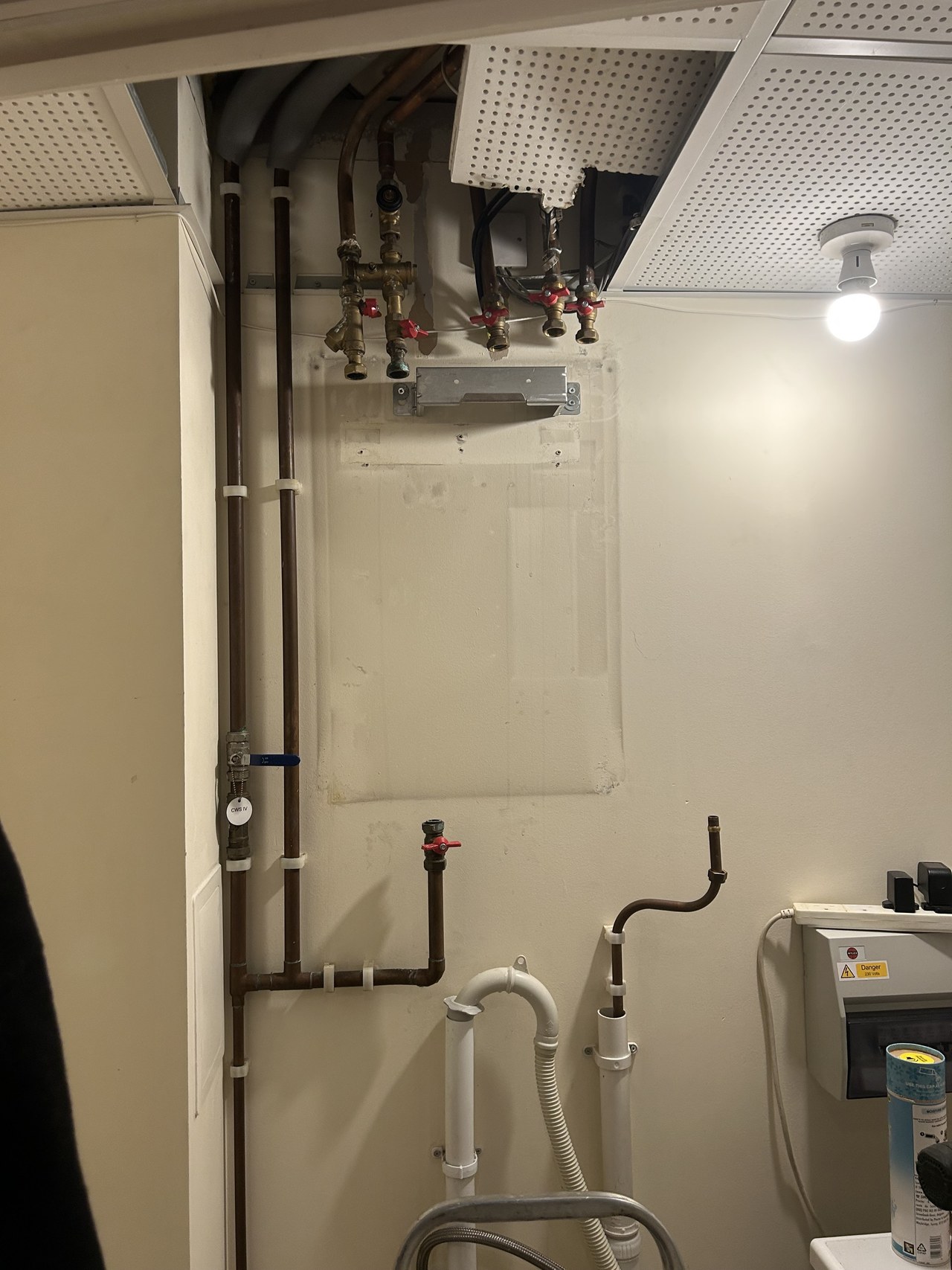
First, stop it if you can
There are usually two valves on the pipework either side of the unit, one on the flow and one on the return. They are typically lever handles. Turning them so the lever sits across the pipe closes them.
If you can reach them easily and they turn without force, close them. If they are seized, stiff, or behind something, leave them: a valve snapped off a live pipe is a much worse problem than the leak you started with.
Put a container or towels underneath and then ring somebody. Take a photograph of where the water is actually coming from if you can see it, because that genuinely narrows the diagnosis.
Why a leak in a flat is urgent in a way it is not in a house
The unit usually sits in a cupboard, and that cupboard usually has somebody else's ceiling under it. A slow leak can run for weeks inside a floor void before anyone sees a stain, and by the time it shows, the damage is to a neighbour's property rather than yours.
That is also why it becomes a dispute about who pays. Establishing quickly that it is stopped, and having a dated photograph of it, is worth doing for reasons that have nothing to do with plumbing.
Where the leaks tend to come from
Joints and unions are the commonest. A heat interface unit has a lot of connections in a small space, and they go through a heating and cooling cycle every day of their life.
The pressure relief or safety discharge is the next. If that is passing, it is often telling you about a pressure problem rather than being faulty itself, which is why a leak there should not simply be capped.
The plate heat exchanger itself can fail, though less often. And occasionally what looks like a leak from the unit is condensation, or a leak from pipework above that is running down the casing and dripping off the bottom of it. That last one matters because fixing the unit would not fix anything.
What not to do
Do not open the casing to look. Do not tighten a fitting to try to stop a drip, because on a heating system a fitting that is weeping is frequently a fitting that will shear. Do not put a bucket under it and leave it for a month, which is the one we see most.
And do not assume a small leak will stay small. The pressure behind it does not go down on its own.
How to tell where the water is actually coming from
Before anyone comes out, a couple of minutes looking can narrow this considerably, and it is all observation rather than touching anything.
Dry the area underneath completely, put a sheet of kitchen paper down, and come back in an hour. Where the paper is wet tells you a great deal more than a damp patch that has spread across a cupboard floor overnight.
Look above the unit as well as at it. Pipework runs through these cupboards, and a leak from a joint above will run down the casing and drip off the bottom, which looks exactly like the unit leaking. Fixing the unit would fix nothing.
Note whether it leaks all the time or only when the heating runs. A leak that appears when the system heats up points at expansion, pressure and the relief valve; a constant one points at a joint or a union.
Check whether the pressure gauge is falling at the same time. If the gauge drops as the puddle grows, the water is coming from your heating circuit. If the gauge is steady, it is more likely to be from the building's side or from the hot water circuit, which is a different repair.
Photograph all of it. A dated photograph is worth having for the repair and, if the flat below is affected, for reasons beyond the repair.
On the facts in this guide. How a heat interface unit works is described here from the plate heat exchanger principle common to every make. Anything that would differ between manufacturers, including error codes, set pressures and service intervals, is deliberately not stated as a number: check your own unit's manual or ask whoever manages the building.
Questions people ask
There is a small drip. Can it wait?
It can wait for an appointment, but not for months. The thing that makes a small drip expensive in a flat is where the water goes, not how fast it comes out.
Will this be covered?
That is between you, your policy and your building's arrangements, and we cannot tell you. What helps either way is a dated photograph of the leak and a record of when you reported it.
Who is responsible, me or the building?
It depends on your lease and it varies genuinely between developments. In many, the unit inside the flat is the leaseholder's and the system up to it is the building's. Ask your managing agent.
Can you fix it or does the unit need replacing?
Usually fix. A joint, a union or a valve is a repair. We would tell you if it were a replacement, and a replacement is £750 labour with the unit and materials separate.
Can I just close the valves and leave it closed?
You can, and you will have no heating or hot water while they are. It is the right short term move and not a solution.
Can I use the heating while it is leaking?
If the leak is small and you have not closed the valves, the system will run, but you are letting water escape somewhere you cannot see. If the leak is coming from your heating circuit the pressure will keep falling, and topping it up repeatedly makes the corrosion worse rather than solving anything.
The leak only appears when the heating is on.
That points at expansion. As the system heats the water expands, the pressure rises, and a joint or a relief valve that holds at rest gives way under it. It is a useful observation and worth mentioning when you ring, because it changes where we look first.
Should I tell the managing agent?
Yes, early, even if you think the unit is yours to fix. If water has reached the flat below, the agent will be involved whether you tell them now or later, and a dated report from you is considerably better than a complaint from downstairs arriving first.
Call us for your instant no-obligation quote
Tell us what needs doing and we will tell you what it takes. No obligation, and nothing starts until you have agreed the price.
Get in touch
Tell us what is happening and where the property is. A photo of the unit, the fault code or the leak answers more than a paragraph does.
The plumber was really good. He fixed the HIU that was leaking. Now it doesn’t leak anymore, and everything works perfectly. He did a great job!
Good HIU service, knows his staff well and very quick and the gentleman even helped fixed error code on ambiente heating system, which was not part…